For many businesses, a website starts as a box-ticking exercise:
- “You need a website.”
- “Let’s get something live”.
- “Job done.”
But the businesses that really grow don’t treat their website as a finished product. You could say they treat it as an evolving marketing hub, something that supports sales, content, SEO, campaigns, and future plans.
We see this a lot. A good looking website does not mean you get immediate conversions, ranking, or sales. Say it louder for the people at the back. Some websites look great, but they’re holding back on their full potential. Others become powerful growth tools because they’re built with scale in mind from day one.
So what’s the difference? Let’s break it down.
your website isn't just a brochure
A scalable website doesn’t just exist online. It works hard behind the scenes. Think of your website as:
- your first impression
- your sales assistant
- your content hub
- your data collection point
- the foundation for every future digital campaign
If your website can’t support SEO, content marketing, PPC campaigns or performance tracking, growth becomes expensive, messy, or impossible. This is why a modern web design and web development shouldn’t be separated from a digital marketing strategy.
having the right foundations
Before thinking about traffic or leads, your website needs solid foundations. Otherwise, growth puts strain on the (already existing) cracks. That means:
- clean, well-structured code
- fast load speeds (especially on mobile)
- clear site architecture
- good UX (user experience)
- flexible templates and layouts
- CMS functionality that doesn’t fight back
Google has been open about this for years. Their Core Web Vitals focus on performance, stability and usability because poor experiences lose users…fast. Your website build needs to be designed to grow with you. This is when Laravel really takes centre stage!
your website = your marketing hub
I get it, calling your website a “marketing hub” sounds like boring marketing jargon. But it’s true. A scalable website doesn’t sit on its own, it connects everything together.
content marketing
Content comes in all shapes and sizes. Blogs, landing pages, guides, case studies, whitepapers, and emails, your website should make publishing and updating content easy. But what makes content, good content?
Google does and can penalise your website if content does not offer viewers added value, or you keyword stuff (a big no no with Google), or if it’s hard to read/understand. Strong content supports:
- SEO visibility
- thought leadership
- sales conversations
- long-term traffic growth
- uniqueness
- added value (over your competitors)
This is why content marketing has to start at the design stage, not added months later.

SEO starts at day one
Incoming more boring jargon. Search engine optimisation (SEO) works best when it’s part of the build, and not an afterthought. SEO is important to a web design build. It plays a role in: the menu design and functionality, navigation, UX (user experience), UI (user interface), CTAs (call to actions) location, and more. A scalable site considers:
- keyword focused page structure
- logical internal linking
- crawl-friendly navigation
- technical SEO best practice
Over 50% of website traffic still comes from organic search, making organic SEO one of the most sustainable growth channels available.
This is where SEO and web design need to work together.
PPC and landing pages
Running paid ads? Then your website needs to support them properly. High-performing web designs include:
- dedicated landing pages
- clear CTAs
- minimal distractions
- fast load times
- conversion tracking
- clear, concise, valuable content
Without this, PPC budgets get wasted, not because ads don’t work, but because the website can’t convert its traffic when it does come.
data, data, data
the difference between guessing and growing
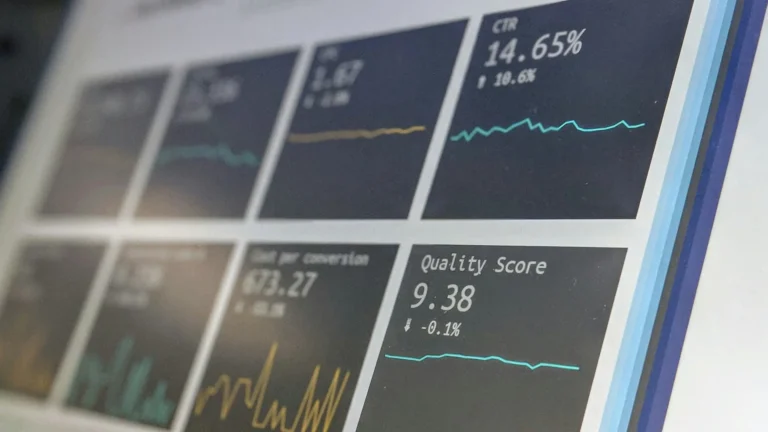
If you can’t measure it, you can’t improve it. Growing websites are built with data in mind, think of Google Analytics integration, GSC, conversion tracking, performance monitoring. This data tells you:
- where users drop off the website
- which pages convert
- what content performs best
- where opportunities are being missed
- what people search to find you
Data-driven organisations are significantly more likely to acquire customers and outperform competitors.
design that supports growth
not just aesthetics
The look and design of a website still matters. But a scalable web design is about clarity. Good UX design keeps users engaged longer, builds trust faster, and makes conversion easier. That means having:
- strong visual hierarchy
- clear CTAs
- consistent branding
- accessible layouts
- UX design that guides users naturally
As a web design Yorkshire agency, we make sure every build we do is not only bespoke to your business and brand, but is optimised and scalable to grow with your business. We have worked in a variety of industries, including e-commerce businesses.
Whether you know exactly what you want, or don’t know where to start, we offer a free consultation to all. Drop us a message for a chat and we look forward to hearing from you.