A new website should feel like a step forward.
- Better design
- Better performance
- More leads
But here’s the reality…a lot of website redesigns don’t deliver.
- Traffic drops
- Conversions stall
- Teams end up back at square one (with less time and more budget spent, ouch)
So what’s going wrong? And more importantly…how do you avoid it?
the problem
focusing on looks over performance
Don’t get us wrong, how a website looks and flows is really important. It’s not just about web design but a big emphasis on the web development aspect as well. One of the biggest mistakes we see is treating a website redesign as JUST a visual project, not a business tool.
Yes, design matters. But design without strategy means underperformance occurs. A successful website needs to:
- Attract the right audience
- Guide users clearly and easily
- Convert traffic into enquiries
- Support your wider marketing (SEO, PPC, content, social media campaigns)
If those things aren’t added in from the start, the redesign is already on shaky ground.
7 reasons website redesigns fail
let's break down the most common issues
- no clear objectives
“We just want something more modern.” That’s not a strategy unfortunately, it’s a starting point at best. Without clear goals, you can’t measure success, because you don’t know what to look for and measure. You need to think about what you want to get out of your website. A redesign should answer:
- Are we generating more leads?
- Are users staying longer?
- Are conversions improving?
- Are users downloading?
If not, what was the point?
- SEO gets ignored until it’s too late
Boring perhaps, but this is a big one (and one we’ve spoken about before in a previous blog). I’m not just saying this as the SEO specialist sat here writing this blog hyping up SEO, but if SEO isn’t part of the build from day one, you’re going to see some issues pop up:
- Rankings often drop after launch
- Page structures don’t support search intent (so Google won’t understand it either)
- Content has to be rewritten later (timely and costly)
We’ve seen redesigns go live and lose visibility overnight simply because SEO wasn’t considered early enough. A strong SEO strategy should guide:
- Site structure
- Page content
- Content intent
- Internal linking
- Technical setup
- Poor user experience (UX)
This one needs to be factored in at the start of a new build project. If users can’t find what they’re looking for quickly (think of the 3 click rule) they leave. Data doesn’t lie. Common issues we see:
- Confusing navigation
- Too many clicks to get to key pages
- Cluttered layouts
- No clear journey
- No clear objective
Good UX design isn’t about being clever, it’s about being clear.
4. “Let’s Just Try It” design decisions
We get it, creativity is important. But when design decisions are made without reasoning, you end up with:
- Inconsistent layouts
- Mixed messaging
- A disjointed user experience
Every element should have a purpose:
- Why is this here?
- What is it guiding the user to do?
5. No conversion strategy
A surprising number of websites look great, but don’t ask users to do anything. There could be multiple reasons for this but some common ones are:
- No clear call-to-actions (CTAs)
- No clear contact points
- No clear lead capture opportunities
A website should actively guide users towards the objective you want (and they want), for example:
- Enquiring
- Booking
- Getting in touch
- Downloading
- Purchase
6. Not built for marketing
Your website isn’t just a standalone asset, it represents you and your business. It should support:
If your site isn’t built to integrate with your marketing, you’re limiting its potential.
7. No tracking or data
If you’re not tracking performance, you’re guessing and you’ll never know what’s doing well, what’s underperforming, what needs improving, what users are liking, and where your bounce rates are. We still see websites launched without:
- Google Analytics properly set up
- Conversion tracking in place
- Defined KPIs
That means no insights, no optimisation, no growth.
how to get it right first time
Here’s what separates a successful redesign from a failed one.
start with a strategy (not just design)
You want to set the direction for everything else, so before anything is designed or built, define:
- Your goals
- Your audience
- Your key pages
- Your conversion actions
build seo into the foundation
SEO shouldn’t be added later, as we’ve already established, it should shape the build. SEO isn’t just keywords, it covers a lot more ground. This includes:
- Keyword research
- Content writing
- Understanding buyer intent
- Persuasive content and CTAs
- Site structure
- Technical SEO setup
- UX and UI (user experience and user interface)
- Data analysis
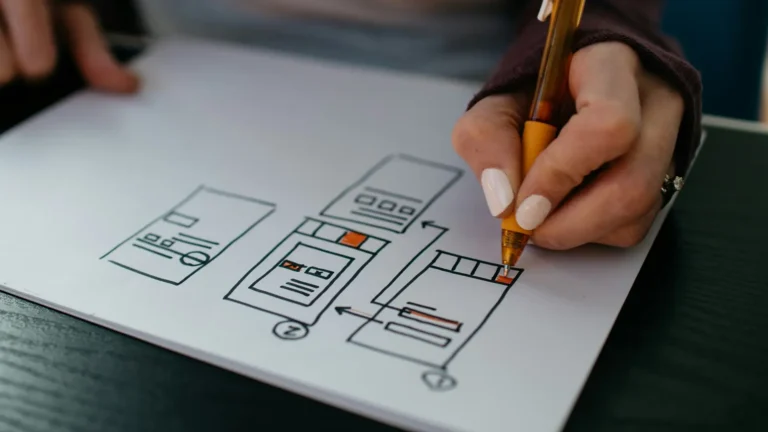
- Website structure / wireframe
This is where strong search engine optimisation and content planning come together.
prioritise UX and clarity
One of the biggest and trickiest things to sort with a redesign website, if it’s done wrong, is correcting the navigation and user experience (UX). We want to make it easy for users to:
- Understand what you do
- Navigate your site
- Find what they want
- Take action
Simple always wins.
design with purpose
It’s not just about looking good it’s about working well. Websites that have had good web design and development, should:
- Support your message
- Guide users
- Reinforce your brand
build for performance and growth
A good website should:
- Load quickly
- Work across all devices
- Be easy to update
- Support future campaigns
Think long-term, not just launch day.
track everything from day one
If you work with us, we will always set up analytics, conversion tracking, and clear KPIs. So we can measure, learn and improve.
what this looks like in practice
At TIG, our web design and development projects bring everything together:
- Digital strategy
- SEO
- UX and UI design
- Content
- Development
- Hosting
- Ongoing optimisation
All working in the right order. Meaning there’s:
- Less rework
- Less scope creep
- Better results from launch
- Less ad hoc spending
planning a website redesign?
If you’re considering a redesign, the goal isn’t just a better-looking website, but a better-performing one. We’ve broken down how we approach high-performing website builds and what to expect from the process.